

A performance review process can be widely used and still fail managers and employees. In one UK survey, 38% of employees said their manager didn’t regularly set targets, while 34% said their progression wasn’t regularly reviewed. In a separate UK study, only 5% of managers were very satisfied with their organisation’s performance management process. These findings, reported by People Management, point to an operational problem, not a lack of interest in feedback.
Managers need protected time, clear objectives, usable evidence, practical training and a process that makes follow-through visible. A polished form won’t fix a review cycle that asks managers to reconstruct a year of performance from scattered emails and incomplete notes.
This guide sets out a practical approach to performance reviews for managers in UK and EU organisations. It covers the foundations, meeting preparation, conversation structure, Microsoft technology, follow-up discipline and a 90-day checklist, with a clear focus on reducing the workload that causes reviews to become late, inconsistent or superficial.
Table of Contents
- Why Performance Reviews for Managers Often Fail in UK Organisations
- Foundations Managers Need Before Running a Performance Review
- Start with observable goals
- Capture evidence as work happens
- Use a template that supports judgement
- Build manager confidence
- Preparing for the Performance Review Meeting
- Running an Effective Performance Review Conversation
- Give feedback that can be acted on
- Handle disagreement without becoming defensive
- Close with owners and dates
- Using HR Systems to Strengthen Manager Reviews
- Follow-Up Actions, Check-Ins and Continuous Feedback
- Manager Checklist, FAQs and Next Steps
Why Performance Reviews for Managers Often Fail in UK Organisations
A performance review fails long before the meeting if the manager lacks time, evidence or a workable process. The UK has spent decades formalising performance management. The Financial Management Initiative introduced monitoring of objectives and performance indicators across government departments in the early 1980s. The Public Service Agreements framework, introduced in 1998, expanded that approach across government before being scrapped in 2010 because it had become too top-down and bureaucratic, as outlined by the Institute for Government.
That history created clear expectations: documented objectives, mid-year discussions and end-of-year appraisals. The operational problem is that managers are often expected to deliver this cycle alongside their normal workload, without protected time, practical training or evidence gathered in one place.
Practical rule: Don’t make managers responsible for review quality without giving them time, evidence and a usable workflow.
The survey findings point to a workload and process failure rather than simple reluctance. Employees are often left without regular targets or progression discussions, while managers report low confidence in the performance process and difficulty addressing
under-performance, as reported in People Management’s UK reporting.

What modern manager-led reviews should achieve
A workable review connects four items:
- Expectations: What the employee was asked to deliver.
- Evidence: What happened, including outcomes and observable behaviours.
- Development: What capability, support or experience is needed next.
- Accountability: What the manager and employee will do, and by when.
Acas recommends regular performance reviews, ideally at least once a year, covering strengths, improvement areas, support or training needs, and career objectives. It also recommends informal conversations throughout the year in its performance management guidance.
Capacity determines whether those requirements work in practice. Research cited by HR Magazine found that many companies believed managers lacked time for proper performance management and ongoing employee conversations, while some managers did not see sufficient value in the process. Better wording cannot solve that gap. A redesigned workflow can reduce administration, collect evidence from routine activity and give managers time to focus on judgement, coaching and agreed actions.
Foundations Managers Need Before Running a Performance Review
A manager shouldn’t enter a review meeting by searching through old emails. Four foundations make the conversation fairer and easier: clear goals, captured evidence, a practical template and manager capability.
Start with observable goals
A goal should describe an outcome or behaviour that another person could understand and assess. “Improve communication” is too vague. “Provide a concise project update at each agreed governance meeting, highlighting risks, decisions and owners” gives the manager something concrete to discuss.
Goals should also reflect the employee’s actual role and current priorities. If business priorities change, update the goal rather than assessing someone against an obsolete expectation. Jointly agreed objectives create a stronger basis for a review than targets written once by HR and forgotten.
Capture evidence as work happens
Evidence should come from ordinary work, not a last-minute research exercise. Useful sources include:
- One-to-one notes: Record decisions, support requests and agreed follow-up.
- Project records: Use delivery milestones, quality checks, customer feedback and retrospective actions.
- Learning activity: Note completed training, applied skills and remaining capability gaps.
- Peer input: Capture relevant observations, while separating fact from opinion.
- Employee reflection: Invite the employee to identify achievements, barriers and development needs.
Store evidence in the approved HR system, not in personal spreadsheets or informal inbox folders. Access should reflect role requirements, and managers should avoid recording unnecessary sensitive information.
Use a template that supports judgement
A template should prompt useful thinking without forcing managers to write essays. It should link each objective to evidence, outcome, behaviour, development action and next review point. A good form reduces duplication by reusing information already held in the employee record.
Build manager confidence
Managers need training in specific, behaviour-based feedback, listening, documenting concerns and handling disagreement. CIPD’s appraisal guidance recommends clear jointly agreed goals, regular check-ins and evidence-based review conversations. It also stresses that organisations should build manager capability formally instead of assuming every line manager can run an effective appraisal without support.
| Element | Weak Example | Strong Example |
|---|---|---|
| Goal | Improve stakeholder management | Provide agreed stakeholder updates, record decisions and escalate delivery risks promptly |
| Evidence | The team seemed happier | Feedback from project meetings identifies clearer ownership and faster escalation of issues |
| Development | Attend leadership training | Practise structured delegation in the next project and review outcomes at the next check-in |
| Accountability | Keep improving | Manager will provide monthly coaching, employee will prepare a delegation plan, both will review progress at the next meeting |
Preparing for the Performance Review Meeting
Preparation starts by checking whether the objectives still make sense. Compare the employee’s goals with current team priorities, changed responsibilities and any agreed adjustments. Don’t assess someone against a target that the business has already replaced.
Next, gather evidence from the year and organise it against each objective. Look for outcomes, quality, collaboration, judgement and behaviours, not just activity. A manager who lists tasks without considering impact may produce a busy review that says little about contribution.
Form a balanced view
Draft a concise view of:
- What went well: Include specific results, strengths and positive behaviours.
- What needs attention: Describe the gap, its impact and the expected improvement.
- What affected performance: Consider resources, priorities, dependencies, health, absence or changing circumstances.
- What happens next: Identify support, development and measurable follow-up.
Long-term absence requires care. Don’t treat time away as evidence of poor performance, and involve HR where absence, reasonable adjustments or medical information may affect the discussion. Hybrid working also needs evidence based on outputs and agreed behaviours, not assumptions about visibility.
If previous feedback was poor or incomplete, acknowledge that history and avoid pretending the record is stronger than it is. Where performance concerns may lead to formal action, follow a fair process and obtain HR advice before the meeting.
Make the meeting workable
Schedule enough uninterrupted time and provide the employee with the purpose and agenda in advance. For a hybrid meeting, confirm privacy, test the video link and avoid conducting a sensitive discussion from an open office or shared workspace.
A useful agenda covers achievements, objectives, behaviours, development, support and next priorities. Give the employee space to prepare their own view. That two-way design reduces the risk that the manager arrives with a verdict rather than a conversation.
Before joining, check that you can answer these questions:
- Which objectives were agreed?
- What evidence supports each conclusion?
- What has changed since the objectives were set?
- What does the employee need to explain?
- What action will follow each development or performance issue?
- Which points require HR involvement?

A digital workflow can make this preparation repeatable rather than dependent on personal organisation.
Running an Effective Performance Review Conversation
The manager sets the tone in the opening minutes. Explain that the purpose is to review contribution, understand the employee’s perspective, agree support and define what happens next. Then invite the employee to speak before presenting the manager’s assessment.
Useful prompts include:
- “What’s your read on this quarter?”
- “Which achievement are you most proud of?”
- “What made delivery difficult?”
- “What support would make the biggest difference?”
- “Which goal should we adjust for the next period?”
Listen for context without abandoning accountability. An explanation may change the manager’s understanding of an outcome, but it doesn’t automatically remove the need to address a gap.
Give feedback that can be acted on
Use a simple structure: describe what you observed, explain the impact and agree the next move. For example: “Here’s what I observed, here’s the impact, and here’s how I’d like us to move forward.” Keep the feedback recent, specific and connected to behaviour or results.
Avoid labels such as “not committed” or “difficult”. Describe the situation instead. “Three agreed updates were missed, and the project team received risk information late” gives the employee something they can respond to.
Balanced feedback doesn’t mean hiding a serious concern between compliments. Recognition should be genuine, while improvement points should be clear enough to guide action.
Handle disagreement without becoming defensive
If the employee disputes a rating or conclusion, ask which evidence they believe is missing. Compare both accounts with the agreed objective and supporting records. If the manager needs time to check information, say so and pause the decision rather than arguing from authority.
Under-performance requires a clear description of the standard, the gap, the support available and the review point. Quiet disengagement needs curiosity before judgement. Ask about workload, role clarity, team relationships and barriers to contribution.
Mental health pressures, caring responsibilities and other personal circumstances may affect how the manager should provide support or make adjustments. Don’t ask for unnecessary private details. Focus on work impact, available support and appropriate HR guidance.
Close with owners and dates
The manager should summarise the agreed position, but not dictate a conclusion the employee hasn’t had a fair chance to discuss. Every action needs an owner, a date and a definition of completion.
A review form records the conversation. It doesn’t create a fair conversation.
The quality of the exchange matters more than the software or paper form. Technology should help the manager arrive prepared and leave with clear commitments.
Using HR Systems to Strengthen Manager Reviews
A well-designed HR system removes administration without removing judgement. The manager should see objectives, review history, feedback, development actions and relevant employee information in one controlled view, rather than reconstructing the record from emails and spreadsheets.
Microsoft technology provides a practical foundation. Dataverse can connect performance information with employee, learning, talent and organisational records. Power Automate can send reminders, request evidence, route approvals and escalate overdue actions. Power BI can help HR identify incomplete reviews, recurring capability gaps and patterns across teams, provided reporting is designed with appropriate access controls.
HRManagement365 is a UK and EU HR solution powered by Hubdrive and Microsoft technology. It is built in Power Platform, Dynamics 365 and Dataverse, and extends Hubdrive and Microsoft with HRManagement365 expertise, integrations, customisations, workflows and HR applications. Where a customer has a specific process, custom functionality and additional applications can be developed across the employee lifecycle.
For organisations using Dynamics 365 Business Central or Finance and Operations, integration can reduce duplicate workforce information and connect HR activity with finance and operational planning. Microsoft 365 tools such as Teams, Outlook, Word, Excel and Power BI can support familiar manager and employee experiences.
UK and EU deployments still require careful design. UK employment practice, right-to-work checks and records governance aren’t identical to EU employment, payroll, tax or works council requirements. GDPR controls should cover access, purpose limitation, retention and auditability, with country-specific processes configured where necessary.
| Manager Task | Without System | With HRManagement365 + Dynamics 365 |
|---|---|---|
| Find objectives | Search email, documents and spreadsheets | Review objectives from a connected employee record |
| Gather evidence | Request updates manually | Trigger structured evidence requests and reminders |
| Prepare meeting | Reconcile disconnected notes | View goals, feedback and actions in one place |
| Track development | Maintain a separate action list | Link development actions to training and skills records |
| Monitor completion | Rely on personal follow-up | Use workflow status, alerts and Power BI reporting |
| Escalate concerns | Forward records to HR manually | Route defined approvals and actions through controlled workflows |
The system should surface the facts, not decide the rating. Managers remain accountable for context, fairness and the final conversation.
Follow-Up Actions, Check-Ins and Continuous Feedback
A review becomes useful only when the agreed actions appear in the employee's working routine. Document the outcome promptly, ideally within 48 hours, and send the employee a short summary covering the assessment, key evidence, development priorities, support and next dates.
Don't create a development plan that nobody checks. Each action should identify the owner, expected outcome and review point. A training course may be appropriate, but so might shadowing, project responsibility, coaching, clearer delegation or access to a subject-matter expert.
Schedule regular check-ins rather than waiting for the next annual meeting. Monthly or quarterly conversations can test whether priorities remain relevant, whether support is working and whether a concern needs early HR involvement. Acas also supports informal performance conversations throughout the year, alongside the formal review process.
Simple dashboards help managers see overdue actions and unresolved objectives. HR can use Power BI to identify where reviews remain incomplete or where development needs recur across teams, while respecting confidentiality and role-based access.
Use AI as an assistant, not a decision-maker
AI can help draft a review summary from approved records, suggest development resources or identify themes in structured feedback. It shouldn't determine ratings, infer sensitive personal circumstances or replace a manager's judgement on conduct, capability or fairness.
UK reporting found that 52% of people managers had used generative AI in their role, and 59% of those users said they used it for performance reviews and feedback, as reported by People Management. That adoption makes governance essential. Managers should check every generated draft, avoid entering unnecessary personal data into unapproved tools and tell employees how AI has been used where organisational policy requires transparency.
An effective follow-up process protects trust because employees can see that the review affected priorities, support and development rather than disappearing into an HR archive.
Manager Checklist, FAQs and Next Steps
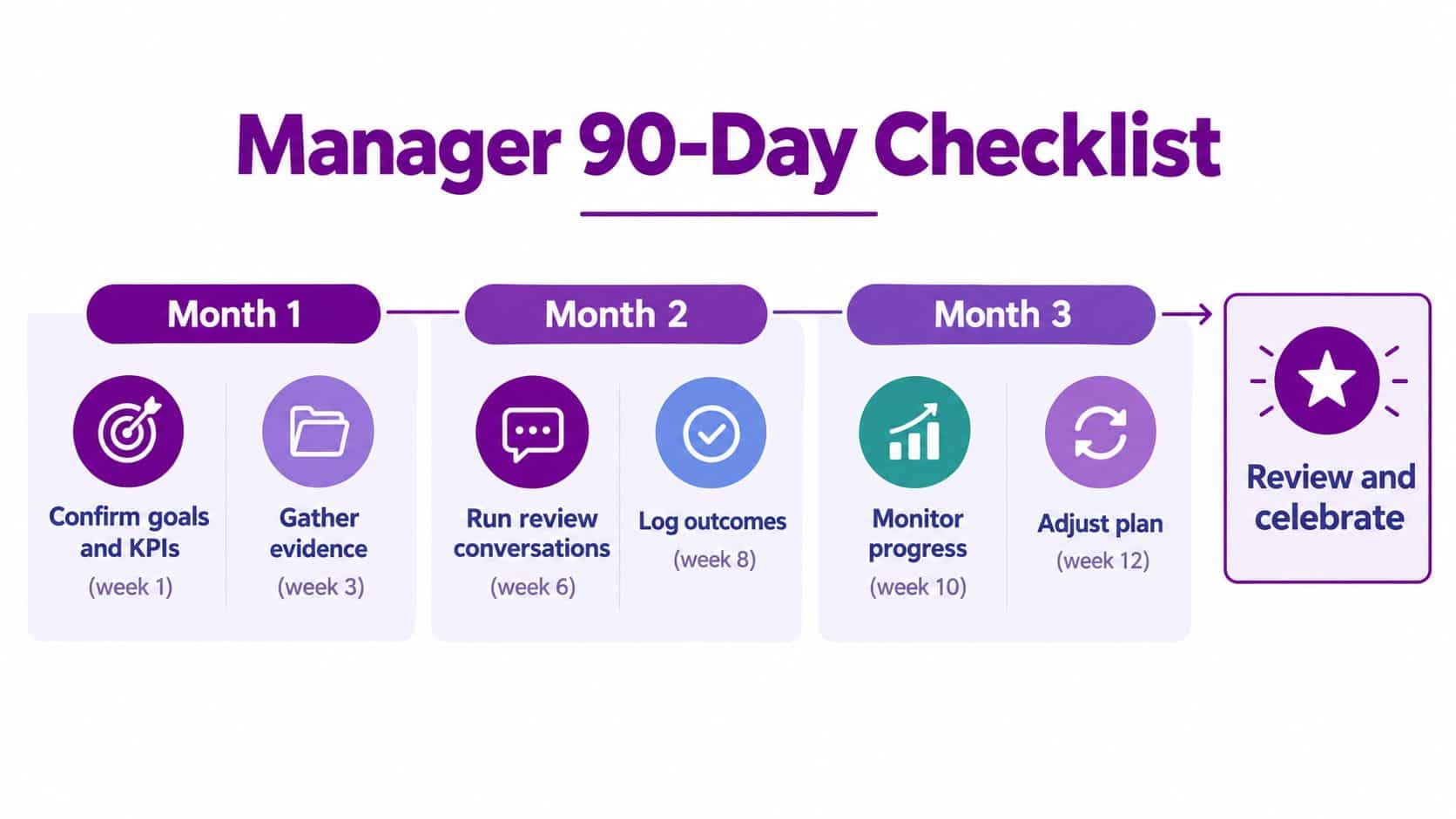
Use the next 90 days to turn performance reviews for managers into a working rhythm:
- Week 1: Confirm role objectives and KPIs with each employee, checking alignment with current priorities.
- Week 3: Gather evidence from one-to-ones, projects, feedback and employee reflections.
- Week 6: Hold review conversations using a shared agenda and a two-way discussion.
- Week 7: Log outcomes, development actions, owners and dates.
- Week 12: Review progress, adjust plans and schedule the next quarterly check-in.
Frequently asked questions
How often should managers run performance reviews?
Acas says reviews should be regular, ideally at least once a year, and managers should hold informal performance conversations throughout the year. An annual formal review can provide a clear record, but it shouldn't be the only meaningful discussion.
Are performance ratings required by UK law?
There is no general UK legal requirement for employers to use numerical performance ratings. Organisations can choose a suitable approach, but their process should be clear, consistently applied and supported by evidence. Contractual terms, internal policy, collective arrangements and the circumstances of a capability or disciplinary process may still matter.
How should a manager document poor performance fairly?
Record the agreed expectation, the specific gap, its impact, the employee's response, support offered and the date for review. Keep the language factual and avoid diagnoses, assumptions or exaggerated labels. Seek HR advice where the issue may lead to formal capability or disciplinary action.
What should happen if an employee disputes the record?
Invite the employee to identify inaccuracies and add their response to the record. Check the underlying evidence, correct factual errors and retain a clear note of unresolved disagreement if the conclusion remains different.
How should reviews align with Acas procedures?
A routine performance review isn't the same as a disciplinary or grievance process. If concerns may lead to formal action, follow the organisation's procedure, provide a fair opportunity to respond and take appropriate HR advice. Keep performance coaching, capability management, conduct issues and grievances distinct.
How long should review records be kept?
The ICO says employers should periodically check that employee records remain relevant and adequate, delete information no longer needed and maintain a retention schedule describing the record type, purpose and retention period, as set out in its employment records guidance. HMRC's records policy gives a default standard of six years plus the current year for its records, meaning six years after the last entry plus an additional current accounting year before review or destruction, as explained in the HMRC records management policy. That HMRC standard shouldn't be treated as a universal retention rule for every employer or every HR record.
Performance reviews improve when managers have time, evidence and a process that supports follow-through. If your organisation already uses Microsoft Power Platform or Dynamics 365, a working session can identify which review tasks to automate, which data to connect and where custom workflows or applications would remove avoidable administration.
Speak to an HRManagement365 specialist about implementing performance reviews, manager workflows, evidence capture, development tracking and reporting across your Microsoft environment. Discover how HR Management 365, powered by Hubdrive and Microsoft, can help improve and automate your HR processes across the UK and EU, then phone +44 1522 508096 today or send us a message through the HRManagement365 contact page.


