
UK employers now outsource at least some HR functions in the majority of cases, and that makes the old “cheap admin support” view of outsource HR UK too small for 2026. A 2023 UK HR outsourcing study found 63% of employers were outsourcing some HR work, up from 53% the year before, with payroll and case management the most common functions to externalise (UK HR outsourcing study summary). For mid-market leaders, the question isn't whether to outsource. It's whether the outsourced model reduces risk, improves control, and connects properly with the systems your business already runs on.
| Option | What you get | Best fit | Main limitation |
|---|---|---|---|
| In-house HR | Direct control, internal culture knowledge, closer manager support | Complex employee relations, culture-building, senior talent planning | Fixed cost, single-point capacity, software overhead |
| Traditional outsourced HR | External advice, document support, process cover | Businesses needing compliance help and day-to-day HR admin | Can be fragmented, less integration, slower data flow |
| Tech-enabled HR platform | Workflows, self-service, reporting, audit trails | Microsoft-centric organisations wanting connected HR operations | Needs proper configuration and governance |
For UK and EU organisations, the strongest outsourced model is no longer just a service desk. It's an integrated operating layer that helps HR, finance, and managers work from the same records, approvals, and reporting.
Table of Contents
- The Strategic Shift Towards Outsourcing HR in the UK
- Analysing the True Cost of Outsourced HR Services
- Comparing Traditional Agencies and Tech-Enabled HR Platforms
- Navigating UK Compliance and Right to Work Liabilities
- Deciding Which HR Functions to Outsource or Keep In-House
- Choosing a Microsoft-Integrated HR Partner for Sustainable Growth
- Next Steps for Transforming Your HR Operating Model
The Strategic Shift Towards Outsourcing HR in the UK
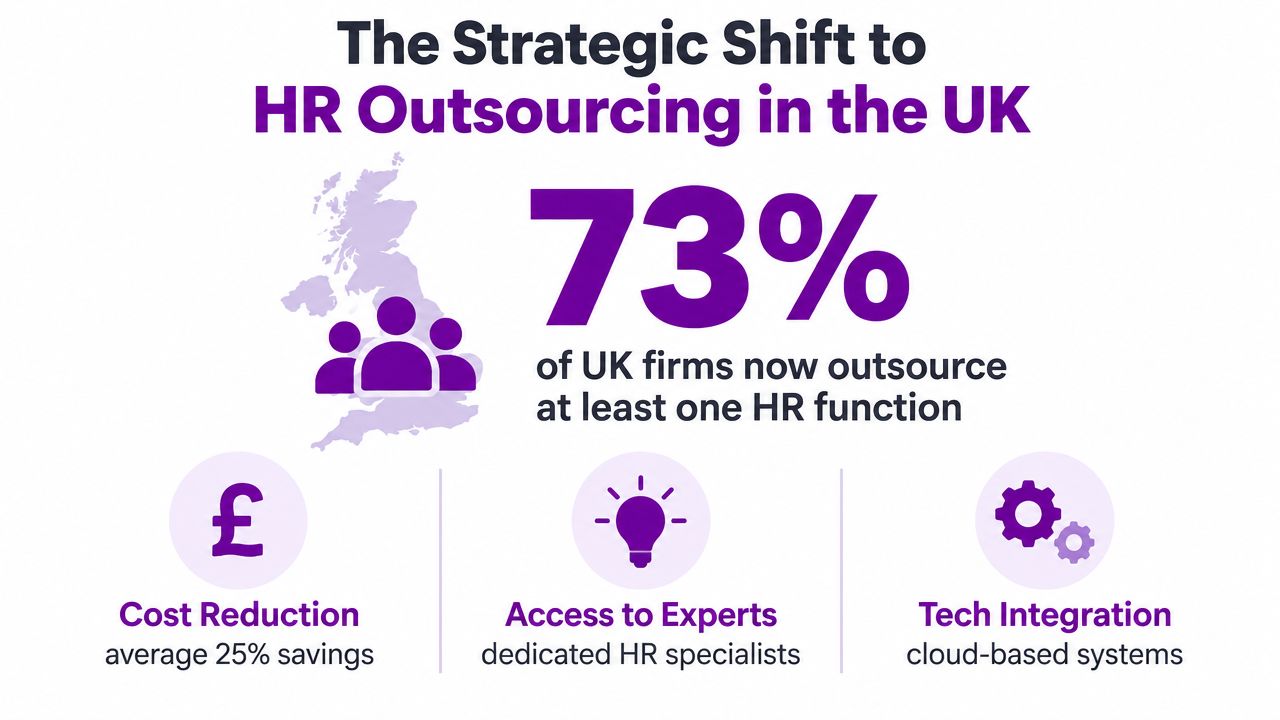
UK employers have already moved past the idea that outsourcing is only for smaller firms. An infographic on UK outsourcing patterns notes that 73% of companies outsource HR functions to save costs and access specialists (An infographic showing that 73% of UK companies outsource HR functions to save costs and access specialists.). Separate UK analysis also found 63% of employers outsourced at least one HR function, with earlier data showing 29% already outsourcing some HR activity, 20% reporting significant increases over five years, and 44% reporting slight increases (UK HR outsourcing study summary). This is now a mainstream operating choice.
Why leaders are changing the model
Specialisation is the first driver. HR leaders outsource because repeatable work benefits from legal consistency, process discipline, and a provider that sees the same issue across multiple employers. Payroll, starter and leaver administration, policy maintenance, and routine case handling fit that model better than improvised internal fixes.
Practical rule: outsource the repeatable work, keep judgement-heavy work close to the business.
Technology is the second driver. HR services built around separate portals, spreadsheets, and inboxes tend to create delays, missing evidence, and version-control problems. A model running inside Microsoft 365, Power Platform, Dynamics 365, and Dataverse can route tasks, store documents, and surface reporting in a form managers use. That matters for organisations already standardised on Microsoft, because the HR process can sit inside the same environment as finance and operations.
HRManagement365 sits in that space as a UK and EU HR solution powered by Hubdrive and Microsoft technology, with implementation and process design built around the Microsoft stack rather than bolted onto it. The commercial point is simple. Outsourcing can become part of the operating model, not just a supplier relationship. For a closer view of the service layer, see HR services management.
The compliance risk is easy to miss. Generic outsourcing often separates records from workflows, which leaves gaps in audit trails, approval history, and evidence for right to work, absence, or disciplinary decisions. Integrated HR operations reduce that fragmentation, especially where UK teams also support EU activity and local rule variation still has to be handled carefully.

Analysing the True Cost of Outsourced HR Services
The cost conversation is where many outsourcing decisions stall, because buyers compare a monthly fee with a salary and stop there. UK pricing is usually structured as a retainer, per-employee pricing, or ad hoc hourly support. The data you can work from is a retainer band of roughly £100–£800+ per month, with a narrower operational range of about £150–£600 per month for small-to-mid-sized employers, plus £20–£50 per employee per month for per-head pricing and £60–£150+ per hour for ad hoc work (UK outsourced HR pricing overview).
How to read the numbers properly
Those prices only make sense if you know what the provider is doing. A low-cost service may cover basic compliance and advice. A higher retainer may include workflow support, case management, document control, and manager self-service. The point is not to find the cheapest offer, it's to match the commercial model to the service depth you need.
For smaller businesses, the comparison is even starker. A UK SME with 20 to 50 employees is often estimated to pay £600–£1,800 per month for retained outsourced HR, while an in-house HR manager is cited at around £35,000–£55,000 annually, which works out at roughly £2,900–£4,600 per month equivalent (UK small business outsourcing benchmark). That's before you account for recruitment, onboarding, leave cover, and the software footprint needed to support an internal role.
| Cost Factor | In-House HR Manager | Outsourced HR Retainer |
|---|---|---|
| Base cost | Salary, employer costs, and overheads | Fixed monthly fee or modular pricing |
| Scalability | Fixed headcount commitment | Can be expanded or reduced by service scope |
| Knowledge depth | One person’s experience | Access to multiple specialists |
| Software impact | Often needs additional licences and admin tools | May include workflow and case handling |
| Continuity | Risk if the person leaves | Provider team can absorb absences |
What works in practice is budgeting for the outcome, not just the fee line. If a provider gives you advice but you still have to chase records, re-key employee changes, and rebuild reports manually, the cost is higher than the retainer suggests.
Commercial check: if the proposal can't explain exactly how it handles starter/leaver processing, documents, approvals, and reporting, you're probably buying labour, not a managed HR operating model.
Comparing Traditional Agencies and Tech-Enabled HR Platforms
Traditional HR consultancies still have a place, especially where leaders want a named adviser, sensible case handling, and direct employment-law support. They can be effective when the work is advisory and the volume is modest. The problem starts when the business needs the HR service to behave like part of its systems, not a separate helpdesk.
Where fragmented service models break down
The weak point is data movement. If HR advice sits in one portal, payroll in another, document storage somewhere else, and approvals in email, managers end up re-entering the same facts in multiple places. That creates avoidable friction, makes audit trails harder to defend, and slows down basic processes like onboarding or change approvals. It also means reporting arrives late, which is a real issue when finance and HR need the same numbers.
A tech-enabled HR platform built in the Microsoft ecosystem handles this better because it can use Dataverse, Power Apps, Power Automate, Power BI, Teams, and Microsoft 365 as one connected environment. Microsoft's own Power Platform documentation confirms that solutions can be extended with Dataverse, connectors, Copilot, AI Builder and Power Fx (Microsoft Power Platform documentation). That matters because it lets an HR partner build workflows that fit your process rather than forcing your people to adapt to a generic portal.
Here's a useful outside comparison on service design and human versus automated handling in a different operational context, compare AI vs human call centers, because the same tension shows up in HR. Automation is useful, but it only works when the workflow is well designed and the human escalation path is clear.
The key commercial advantage of HRManagement365 is that it is built in Power Platform, Dynamics 365 and Dataverse, then extended with consultancy, integrations, workflows, and custom HR applications. That lets the platform support employee lifecycle processes, live reporting, and manager self-service without turning the HR operation into a patchwork of disconnected tools. For organisations already using Dynamics 365 or Microsoft 365, that is a material advantage.
Navigating UK Compliance and Right to Work Liabilities
The biggest mistake in outsourcing conversations is assuming the supplier inherits the legal risk. In the UK, that's not how right-to-work compliance works. The employer still holds the obligation to complete the check properly, keep evidence, and defend the decision if challenged.
What the law expects
The Home Office guidance requires employers to complete the check before employment starts, obtain acceptable documents, check that they're genuine and belong to the person, and keep copies or records. If the employee has a time-limited right to work, follow-up checks are required before permission expires (Home Office employer guide). For manual checks, employers must physically examine original documents from List A or List B, make and keep clear copies, and verify the person is the rightful holder and permitted to do the work offered. The guidance also allows the online share-code route and the use of an identity service provider using IDVT (GOV.UK manual check checklist).
The liability side got tougher over time. Right-to-work duties began with the Asylum and Immigration Act 1996, with statutory defence available from 27 January 1997, later strengthened under the Immigration, Asylum and Nationality Act 2006 and the Immigration Act 2016. Remote checks were temporarily adjusted during COVID-19 from 30 March 2020 and ended on 30 September 2022, with stricter verification expectations restored. Civil penalties were then increased from 13 February 2024 to up to £45,000 per worker for a first breach and £60,000 per worker for repeat breaches (right-to-work timeline and penalties).
That's why outsourced right-to-work support needs evidence discipline, not just process convenience. A service provider can help with the mechanics, but the employer still needs retention, audit rights, expiry tracking, and a clear governance model. If the provider can't show how checks are stored and reviewed, the “outsourcing” label isn't doing much for risk.
See the related guidance on right to work checks for employers for a more operational view of what good evidence handling looks like.

Deciding Which HR Functions to Outsource or Keep In-House
Outsourcing works best when you treat HR functions differently, not as one lump. The right answer depends on whether the task is transactional, judgement-heavy, culture-sensitive, or legally exposed. That's why the decision shouldn't start with “what can we send out?”, it should start with “what must stay close to the business?”
A practical decision split
Payroll is the easiest place to externalise because accuracy, deadline discipline, and process consistency matter more than local nuance. Recruitment can also be outsourced when volume is high or hiring managers need help with speed, scheduling, and candidate flow. By contrast, performance reviews and employee relations usually need to stay in-house because they shape trust, management style, and the organisation's tone.
Good rule: if a process changes payroll, record integrity, or compliance evidence, it can be automated or outsourced. If it changes culture, leadership behaviour, or employee trust, keep the decision close.
A sensible outsourced model still needs human judgement inside it. For example, some organisations use external support for policy maintenance and case administration, while their own HR team handles difficult conversations and final decisions. That mix keeps the business in control without forcing HR to spend its time on repetitive chores.
The link to MR2 Solutions augmentation is useful here because it highlights the broader resourcing choice many businesses face, whether to add capacity temporarily or redesign the process itself. In practice, staff augmentation can solve a headcount gap, but it won't fix broken workflows. A Microsoft-connected HR model does both more cleanly when the problem is process design, not just staffing.

Choosing a Microsoft-Integrated HR Partner for Sustainable Growth
A partner's technology stack decides whether outsourcing stays tidy after the first wave of implementation. If the service depends on disconnected portals and manual uploads, the business ends up managing another system instead of simplifying HR. If the service is built around Microsoft 365, Dynamics 365, Power Platform, Dataverse, Teams, and Power BI, HR can sit inside the same ecosystem as finance and operations.
What a connected model changes
HRManagement365 is positioned as a UK and EU HR solution powered by Hubdrive and Microsoft technology, and that matters because the platform is not just a standalone HR tool. It is built on Power Platform, Dynamics 365 and Dataverse, then extended with the provider's own expertise, integrations, workflows, and HR applications. That means customer-specific processes can be handled with custom functionality rather than forcing the business to live with generic forms.
The practical advantages show up in daily work. Employee lifecycle automation can move starters, leavers, and changes through defined approvals. Power Apps can provide employee and manager experiences. Power Automate can remove repetitive tasks and reminders. Power BI can surface live reporting for HR and leadership, while Teams can support self-service without making people learn yet another portal.
This is also where the Microsoft integration with Business Central and Finance & Operations becomes commercially important. HR data can be aligned with finance and operational records, which reduces re-keying and gives leaders a clearer view of headcount, approvals, and workflow status. For organisations that already run Microsoft systems, that connection is often more valuable than a shiny but isolated HR dashboard.
The internal overview of cloud-based HR systems is a useful reference point for teams comparing delivery models. It reinforces the distinction between simple SaaS access and a managed Microsoft-based HR operating model.

Next Steps for Transforming Your HR Operating Model
The right next move is a process review, not a vendor shopping spree. Start by mapping which HR tasks are repetitive, which ones create compliance exposure, and which ones require tight links to finance or operations. Then compare that map with the Microsoft tools you already use, because if you're already on Dynamics 365 or Microsoft 365, the biggest gains usually come from integration, not more admin software.
A good discovery session should cover current pain points, evidence retention, approvals, reporting, and the boundary between outsourced tasks and internal decision-making. It should also test whether the provider can support UK compliance, EU operating realities, and any country-specific payroll or employment differences you need to handle. If the answer depends on too many disconnected tools, the model probably isn't resilient enough for a mid-market environment.
Speak to an HRManagement365 specialist
Discover how HRManagement365, powered by Hubdrive and Microsoft, can help improve and automate your HR processes across the UK and EU.
Phone +44 1522 508096 today
Send us a message:
https://www.hrmanagement365.com/contact/
HR Management 365 gives UK and EU organisations a practical way to connect HR processes, compliance, and reporting inside the Microsoft ecosystem. If you're reviewing outsource HR UK options and want a model that goes beyond basic admin relief, visit HR Management 365 and speak with a specialist about a more integrated approach.